
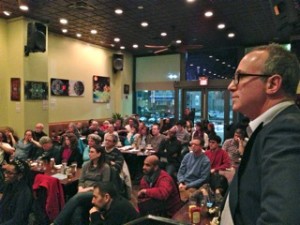
The DC Science Café brings science out of laboratories and lecture halls and into the heart of community life. The lecture series offers a welcoming space where anyone, regardless of scientific background, can explore big ideas, ask questions, and engage in lively conversations about the discoveries and technologies shaping our world. DC’s community of science communicators and journalists, the D.C. Science Writers Association (DCSWA), organizes the event.
Scientists and other experts discuss topics that range from the origins of the universe and the mysteries of gravity to emerging technologies and the ethical questions they raise. Most of the conversation is open dialogue, with audience members encouraged to contribute.
Since its inception in 2011, the DC Science Café grew into a valued science outreach program, helping to connect cutting-edge research with public curiosity and fostering a deeper appreciation for science as a vital part of everyday life.
The series paused in March 2020 due to the COVID-19 pandemic. Founder Ivan Amato noted that he had to cancel an event scheduled for March 23, 2020, as the pandemic was declared.
Now, science writers Martha Heil and James Riordon (a previous DCSWA president) are re-launching the DC Science Café. Their experience as hosts for the award-winning New Deal Café Open Mics, getting fun, popular, and important entertainers to the stage, will inform how they select their speakers and topics.
The first new topic is ‘Heal the Sky: the science of the Antarctic ozone hole and public policy’ presented by UMBC research scientist Paul A. Newman. Other upcoming presentations include: the latest on Moon science by a NASA astrophysicist; DC’s urban ecology and how you can help care for it; ‘This is Your Brain on Psychedelics’; and ten big questions that have very small answers.
Upcoming event:
Heal the Sky: the Science of the Antarctic Ozone Hole and Public Policy by Paul A. Newman: The severe decline of ozone over Antarctica was discovered by Farman, Gardiner, and Shanklin (1985) and was quickly shown to be a continental in scale from NASA satellite observations. Ozone screens the Earth’s surface from harmful solar ultraviolet (UV) radiation – UV radiation is energetic enough to damage bioactive compounds (e.g., DNA). By the late 1980s, observations showed that the ozone hole was caused by human-produced compounds such as chlorine-containing chlorofluorocarbons (CFCs) and bromine containing halons. In this talk he will cover the history and science of the Antarctic ozone hole. In parallel, he will discuss the international agreements the led to the full controls on the consumption and production of human-produced ozone depleting substances. I will also show how the ozone layer is expected to evolve into the future.
Most recent event:
Gravity, or an homage to the mysteries of universal attraction: Without gravity, there would be no up. No down. No falling. No planets with moons. No solar systems. No galaxies. No any of us. Gravity is one of the fundamental forces that governs all that is and how it all came to be over the past 13.7 billion years. Join science writer Ron Cowen and University of Maryland astrophysicist Cole Miller for a gripping tour of gravity that will take you from a 1919 eclipse that really made Einstein’s day, out to the surface of neutron stars and the event horizons of black holes, and back again to the gravitational attraction that keeps you planted on the ground and ever-so-subtly pulled toward every other human being on the planet.