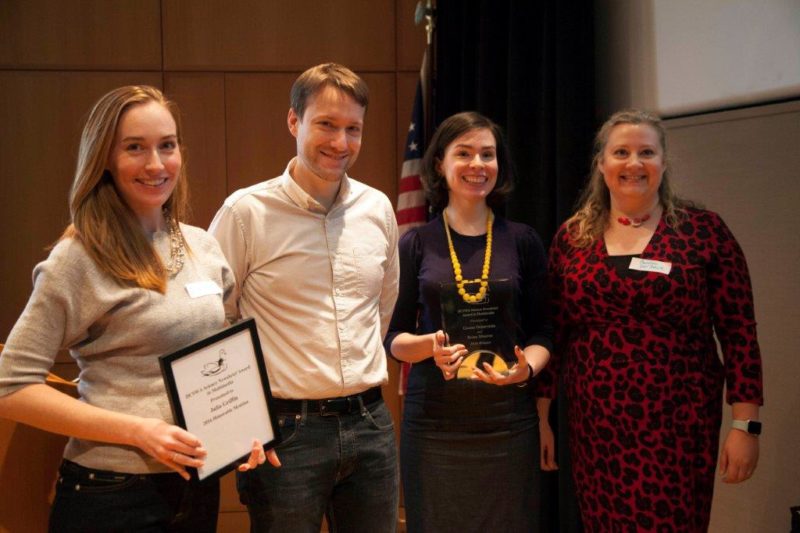
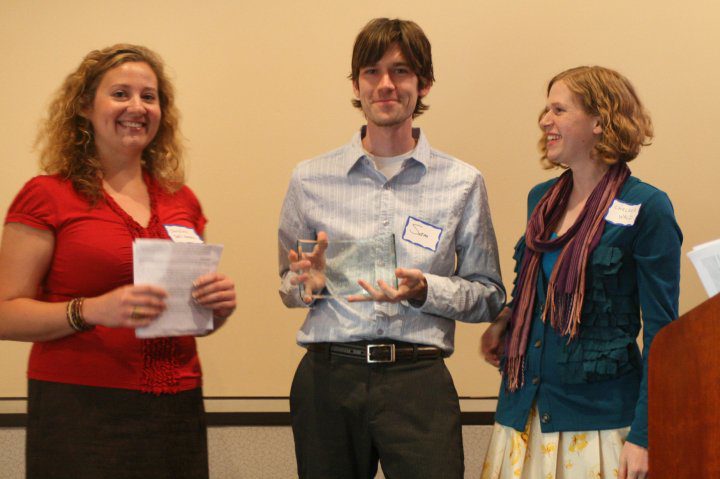
 Genna Duberstein and Brian Monroe (center) receive the 2016 multimedia award for their video “The Electric Wind of Venus.” Julia Griffin (left) receives an honorable mention. Photo by Rich Press.
Stories on ‘bone-collector’ caterpillar, watch-battery warnings win DCSWA Newsbrief Awards
The competition, which is in its 17th year, recognizes excellence in short-form science communication. Winners were announced at the D.C. Science Writers Association’s annual Professional Development Day.
WASHINGTON, D.C. — A charming story about a bone-collecting caterpillar and an informative video about why you shouldn’t swallow watch batteries took top prizes at the 17th annual D.C. Science Writers Association’s 2025 Newsbrief Awards competition.
Longform journalism often gets the field’s accolades, but short pieces are the true workhorses of science communication. In the spirit of recognizing these unsung works of excellence, DCSWA has been offering the Newsbrief Awards since 2009.
A panel of science writers judged entries published during 2025 in two categories: Print/Digital and Broadcast/Audiovisual. The judges named McKenzie Prillaman as this year’s Print/Digital winner for her article in Science News, “This caterpillar wears the body parts of insect prey.”
Prillaman, a science and health journalist based in Washington, D.C, is Smithsonian magazine’s assistant digital editor for science and innovation, specializing in all things life sciences. She loves to explore the intersections between science, society and culture. Prillaman earned a bachelor’s degree in neuroscience from the University of Virginia and a master’s degree in science communication from the University of California, Santa Cruz. Her writing has appeared in Nature, Science News, AARP, and more.
“The writer treated a scientific piece with a literary flair and user-friendly language,” one judge wrote. Judges were impressed by the language and imagery, including exceptional quotes such as “This is a decorate or die situation.”
The judges also awarded an honorable mention for the Print/Digital category to Devin A. Reese for her article “Celestial Poetry Illuminates Astronomy.”
Reese, a published author, is executive editor of Natural History magazine and a regular science writer for Nautilus, VisionLearning, and AZAnimals. She holds a doctoral degree in integrative biology from UC Berkeley and a bachelor’s in animal behavior from Harvard. Reese got her science-communication training on the job during her 20-year career with the Smithsonian Institution in both D.C. and Panama.
Judges commented on the use of global poetry and imagery to learn about celestial natural phenomena like supernovas.
For the Audiovisual/Broadcast category, judges named George Zaidan, writer, Elaine Seward, video producer, and the ACS Reactions team as the winners for the video explainer “Don’t swallow watch batteries.”
“Good science, good impact, good illustrations, good experiment,” one judge wrote. Another said, “Having to physically see the [electrical] current eating through the flesh of the meat made it so powerful. It’s very visceral.”
Zaidan is a writer and host for Reactions, the American Chemical Society’s chemistry-focused YouTube channel in partnership with PBS. He has spent more than two decades in science communication and has worked with National Geographic, TED-Ed and is a published author. Seward has been a video producer with Reactions since its inception in 2014. In that time, she has helped shape the channel’s editorial voice and style across hundreds of videos.
The judges also awarded two honorable mentions for the Audiovisual/Broadcast category. One went to Alex Dainis, writer, and Andrew Sobey, producer, for the Reactions video experiment “Dunking my fingers in a bunch of liquids to maximize wrinkliness.”
“Super engaging, shows good science, and has practical implications,” one judge said.
Dainis is a freelance science communicator and video producer with a doctorate in genetics from Stanford University who has been producing educational content for the web for more than a decade. Sobey, an award-winning nonfiction communicator, is a supervising producer at ACS Reactions along with other ACS video products. He holds an MFA in Science and Natural History Filmmaking from Montana State University-Bozeman.
The other honorable mention went to Ryan Fitzgibbons, producer and writer, Daniel Gallagher, producer, and Katy Mersmann, writer, for the video explainer “Secrets of the Asteroid Bennu Sample.”
“Clear explanation, good science, illustrations, good supplement to the text, convey meaning,” one the judge wrote.
Fitzgibbons is a video producer at NASA’s Goddard Space Flight Center, where he has worked for 17 years. He has an MFA in natural history filmmaking from Montana State University. Gallagher is the lead video producer in the Solar System Exploration Division at NASA’s Goddard Space Flight Center. He has a master’s in cinematography and film and video production from American University. Mersmann is a Webby-award winning social media producer at NASA’s Goddard Space Flight Center and has been at NASA for the last 10 years, covering everything from Earth science to astrophysics to NASA’s OSIRIS-APEX mission. She has a bachelor’s and a master’s in journalism from the University of Missouri.
DCSWA recognized the category winners and honorable mentions at the DCSWA Professional Development Day on Saturday, May 9, 2026.
This year’s judging panel consisted of Sue Eisenfeld, Alyssa Voss, Hanna Webster, Linda Voss and Rachel Lense. DCSWA board member Margarita Yatsevitch, who holds a master’s in science writing from Johns Hopkins University, ran this year’s competition.
The D.C. Science Writers Association is an organization of more than 300 science reporters, editors, authors, and public information officers based in the national capital area. Information about entering the 2026 Newsbrief Awards will be posted in early 2027.
Contact: newsbriefaward@gmail.com
Newsbrief Award Rules
Award History
Past Winners and Honorable Mentions
Rules
- A DCSWA member in good standing as of the deadline is eligible to be the entrant on up to two entries.
- An entry may be submitted either by the individual(s) responsible for it or by a nominator, who does not have to be a DCSWA member.
- There are two categories for which Newsbrief Awards will be given: Print/Digital and Broadcast/Audiovisual. The Print/Digital category includes, but is not limited to: news reports, news feature stories, personality profiles, press releases, commentaries, and blogs. The Broadcast/Audiovisual category includes, but is not limited to: TV, radio, and digital news programs and features; animations; short documentaries; and podcasts.
- Entries must be published or distributed between January 1, 2025, and December 31, 2025. Entries must be submitted as originally published or distributed.
- Entries should be brief. Though there are no strict length limits, please note that judges will strongly favor print/digital work of less than approximately 500 words, broadcast/audiovisual work of less than approximately 4 minutes, and other types of work of equivalent brevity.
- A script/transcript of the written content for broadcast/audiovisual entries must be submitted along with a link to the final produced work.
- As the Newsbrief Awards are for honoring writing skill in a short format, submitters are urged to list only the person or persons primarily responsible for the written content of the entry, rather than the entire production team.
- Entries must be submitted to the form at the link provided with all the required information. For problems or questions with the form, email newsbriefaward@gmail.com.
- All entries must arrive no later than 11:59 p.m. EST on Friday, March 13, 2026. The award winners and any honorable mentions selected will be announced in early April 2026.
- A collaborative writing effort of a team may be submitted, but the entrant must be a DCSWA member, and the names of all team members credited for the entry should be included. Unrelated stories may not be submitted as a single entry, even if by the same author or published/broadcast consecutively.
- The Award will be administered by a Committee that includes at least one member from the DCSWA Board. The Committee will select the Judging Panel. The work of the Award Committee, the Judging Panel, and DCSWA officers is not eligible for the DCSWA Science Newsbrief Award. Board members who are not officers are eligible.
- DCSWA reserves the right to cancel the DCSWA Science Newsbrief Award if the quantity or quality of the collected entries are judged by the Judging Panel to be insufficient to merit recognition. Judges also have the right to select up to two honorable mentions.
Award History
The idea for the DCSWA Newsbrief Award began at the 2007 Metcalf Institute’s Annual Science Immersion Workshop for Journalists, when participants and former DCSWA board members Christine Dell’Amore and Chelsea Wald brainstormed ways to give more credit to science writers who write short pieces. They pitched the idea of an award to DCSWA, which agreed to fund it in 2009.
In the DCSWA spirit of inclusivity, all DCSWA members—journalists, PIOs, bloggers, and other science writers—compete side-by-side for the award. The first prizes were given in 2010 for work completed in 2009. The award is announced at the holiday party and presented at the DCSWA Professional Development Day. The winning writer will receive a prize of $300. Honorable mention certificates will be awarded at the judging panel’s discretion.
We welcome suggestions for how to make the DCSWA Newsbrief Award the best award out there. Please send your ideas to newsbriefaward@gmail.com.
Past winners and honorable mentions
2025 Awards
Print/Digital Winner: McKenzie Prillaman, “This caterpillar wears the body parts of insect prey,” published in Science News.
Audiovisual/Broadcast Winner: George Zaidan, writer, Elaine Seward, video producer, and the American Chemical Society Reactions team for the video explainer “Don’t swallow watch batteries.”
Honorable mentions:
Devin A. Reese, “Celestial Poetry Illuminates Astronomy,” published in Nautilus.
Alex Dainis, writer, and Andrew Sobey, producer, for the Reactions video experiment “Dunking my fingers in a bunch of liquids to maximize wrinkliness.”
Ryan Fitzgibbons, producer and writer, Daniel Gallagher, producer, and Katy Mersmann, writer, for the NASA Goddard video explainer “Secrets of the Asteroid Bennu Sample.”
2024 Awards (Press Release)
Winner: Claire Yuan for her story, “The last woolly mammoths offer new clues to why the species went extinct,” published in Science News.
Honorable mentions: Maria Temming, Aaron Tremper, and Sarah Zielinski of Science News Explores for the TikTok video, “Could a plant ever eat a person?“
2023 Awards (Press Release)
Winner: Bethany Brookshire for “In mice, anxiety isn’t all in the head. It can start in the heart” in Science News
Honorable mentions:
Chris Gorski for “Soccer goalies’ senses and balancing your beverages (Beep-Beep.Flash.Save!)” in Chemical and Engineering News
Bob Hirshon for “Soft Robot Brain Implant” for Science Update
2022 Awards (Press Release)
Writing
Winner: Shi En Kim for “Scientists discover how a cell may cheat its own death” in Popular Science
Honorable mentions:
Carolyn Gramling for “A newfound dinosaur had tiny arms before T. rex made them cool” in Science News and for “A pigment’s shift in chemistry robbed a painted yellow rose of its brilliance“ in Science News
Multimedia
Winner: Katy Mersmann for “Goddard Glossary: Gravitational Lensing” for NASA’s Goddard Space Flight Center
Honorable mentions:
Maria Temming and JoAnna Wendel for “Goldfish driving ‘cars’ offer new insight into navigation” in Science News Explores
Emily Schneider and Janali Thompson for “Easy to Spin Nanofibers, Inspired by Silkworms” for the American Chemical Society
2021 Awards (Press Release)
Writing
Winner:
Isabella Isaacs-Thomas and Megan McGrew of PBS NewsHour for their Instagram post “Women and girls disproportionately impacted by climate change”
Honorable mentions:
Sid Perkins for “Engineers surprised by the power of an elephant’s trunk,” published in Science News for Students
Ariana Remmel for their story “Here’s the chemistry behind marijuana’s skunky scent,” published in Science News
Multimedia
Winner:
Sarah Zielinski and JoAnna Wendel for their comic “Cockatoos learn from each other how to open garbage bins,” published in Science News for Students
Honorable mentions:
Joel Goldberg, with story editing by Catherine Matacic and Kelly Servick and graphics by Ashley Mastin, for the video, “Scientists struggle to ‘awaken’ patients from rare sleep disorders,” published in Science magazine’s YouTube channel
Devin A. Reese, Christie Wilcox, and the SciShow team, for their video “The Stressful Reasons Corals Are Becoming More Colorful,” published on the SciShow channel.
2020 Awards (Press Release)
Writing
Winner:
Jonathan Lambert of Science News for This hummingbird survives cold nights by nearly freezing itself solid
Honorable mentions:
Michael Greshko of National Geographic for Walking back in time, in a volcano’s shadow
Asher Jones for Plastic waste forms huge, deadly masses in camel guts for Science News
Multimedia
Winner: Prabarna Ganguly and Harriet Bailey for The Human Pangenome published by the National Human Genome Research Institute
Honorable mentions:
Theresa Machemer for Good news: daffodils are the worst for SciShow
Asher Jones for New app identifies mosquitoes by buzzing sound for Voice of America.
2019 Awards (Press Release)
Writing
Winner:
Nala Rogers of Inside Science for Plants Get Creative to Fend Off Foraging Insects
Honorable mentions:
Nala Rogers of Inside Science for New Leech Found in D.C.-Area Swamps
Tina Hesman Saey of Science News for Losing genes may have helped whales’ ancestors adapt to life under the sea
Multimedia
Winner:
Helen Thompson and Susan Milius of Science News for How some maggots jump without legs
Honorable mentions:
Sofie Bates of Inside Science for Contact lenses flushed down toilets pollute oceans
Kerri Jansen, Tien Nguyen, and David Vinson of Chemical & Engineering News for How burial methods affect the environment
2018 Awards (Press release)
Writing
Winner:
Emily Conover of Science News for “How ravens caused a LIGO data glitch.”
Multimedia
Winner:
Tien Nguyen of Chemical & Engineering News for “Surprising particle filters made from self-healing soap films.“
Honorable mentions:
Tina Hesman Saey and Helen Thompson of Science News for “What is DNA recombination?”
Helen Thompson of Science News for “How dandelion seeds fly.”
2017 Awards (Press release)
Writing
Winner:
Emily Mullin of MIT Technology Review for “This Gadget Has a Real Working Menstrual Cycle.”
Honorable mention:
Nicholas St. Fleur‘s of The New York Times for “Newly Discovered Gecko Escapes Danger Naked and Alive.”
Multimedia
Winner:
Karin Heineman of Inside Science for “The Bee Dance.”
Honorable mention:
Alexa Billow, Chris Burns and Rachael Lallensack for “Tomato ancestor evolved 50 million years ago near Antarctica” for Science.
Kate Travis and Sarah Zielinski of Science News for “Watch a badger bury a cow.”
2016 Awards (Press release)
Writing
Winner:
Kelly Servick of Science for “Tear your knee? Maybe your nose can help it heal.”
Honorable mention:
Rachael Lallensack of Science for “Watch this tiny robot do a backflip.”
Susan Milius of Science News for“Diversity of indoor insects, spiders adds to life’s luxuries in high-income neighborhoods.”
Multimedia
Winner:
Genna Duberstein and Brian Monroe of NASA Goddard Space Flight Center for “The Electric Wind of Venus.”
Honorable mention:
Julia Griffin of PBS NewsHour for “Why are peacocks’ tail feathers so enchanting?”
Elaine Seward (winner of the 2014 Newsbrief Award) and Sam Lemonick of the American Chemical Society for an episode of ACS’ Reactions series, “Does gum really stay in your stomach for 7 years?”
2015 Awards
Writing
Winner:
Emily Conover for “How to prevent a sheep traffic jam” in Science
Honorable mention:
Tina Hesman Saey for “For penguins, it’s a matter of no taste” in Science News
Emily Underwood for “Rats forsake chocolate to save a drowning companion” in Science
Multimedia
Winner:
Joy Ng, Greg Shirah, and Jefferson Beck of NASA Goddard Multimedia for “What are the chances of another Katrina?”
Honorable mention:
Sophia Cai, Sean Parsons, and Noel Waghorn of ACS for “Why don’t we recycle Styrofoam?”,
Steve Baragona of Voice of America for “Scientists study slums for signs of spreading superbugs”
2014 Award (Press release)
Winner:
Matt Davenport and Elaine Seward for “Why Fruit Flies Could Make Your Beer Better” for Chemical & Engineering News
Honorable mention:
Beth Mole for “Kangaroo gut microbes make eco-friendly farts” in Science News
Mark Zastrow for “The Pattern in Nature’s Networks” for NOVA PBS Online
2013 Award
Winner:
Meghan Rosen for “Paralyzed Rats Relearn To Pee” in Science News
Honorable mention:
Tina Hesman Saey for “Mole Sniffs the World in Stereo” in Science News
Andrew Grant for “Single Electron Caught in Action” in Science News
2012 Award
Winner:
Lauren Wolf for “Building a Jellyfish Mimic with Tissue Engineering” (video) for Chemical & Engineering News
Honorable mention:
Susan Milius for “Bees More Cuckoo Than Birds” in Science News Prime
Meghan Rosen for “All Dinosaurs May Have Had Feathers” in Science News
2011 Award
Winner:
Nadia Drake for “Iapetus Gets Dusted” in Science News
Honorable mention:
Nadia Drake for “Fruit of the Loo” in Science News
Rachel Ehrenberg for “Hidden Dalliance Revealed by X-Rays” in Science News, web edition
2010 Award
Winner:
Sarah Zielinski for “Rare Earth Elements Not Rare, Just Playing Hard to Get” in Smithsonian’s Surprising Science blog
Honorable mention:
Sujata Gupta for “How Mussels Hang On” in ScienceNOW
Rajendrani Mukhopadhyay for “Microscale Mimic Of Human Ingestion” in Chemical & Engineering News
2009 Award
Winner:
Sam Kean for “Mother’s Cancer Can Infect Her Fetus” in ScienceNOW
Honorable mention:
Helen Fields for “Groovin’” in ScienceNOW
Sarah C.P. Williams for “The Power of One” in HHMI Bulletin